Description
Uncompromising Quality Control
At Clear Peptides, quality is verified through independent third-party analytical testing conducted on each production batch. Every peptide is supplied with lot-specific Certificates of Analysis (COAs) confirming identity, purity, and batch consistency.
All materials undergo RP-HPLC purity analysis and ESI-MS identity confirmation before release. No lot ships without passing both tests.
Quality Comparison
| Feature / Testing Standard | Clear Peptides | Other Labs (Avg.) |
|---|---|---|
| Standard COA (Qualitative & Quantitative) | ✔ Included with every lot | ✘ Often incomplete |
| RP-HPLC Purity Analysis | ✔ Every batch, ≥98% criterion | ✘ Inconsistently performed |
| ESI-MS Identity Confirmation | ✔ Every batch | ✘ Rarely provided |
| Lot-Specific Documentation | ✔ Permanently archived, retrievable | ✘ Often unavailable |
| US-Based Fulfillment | ✔ FedEx 2-Day cold-chain | ✘ Variable |
GLOW Triple Blend — Research Overview
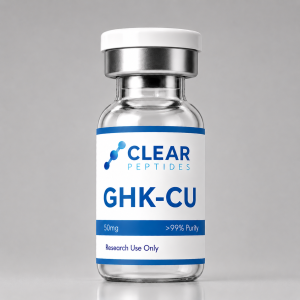
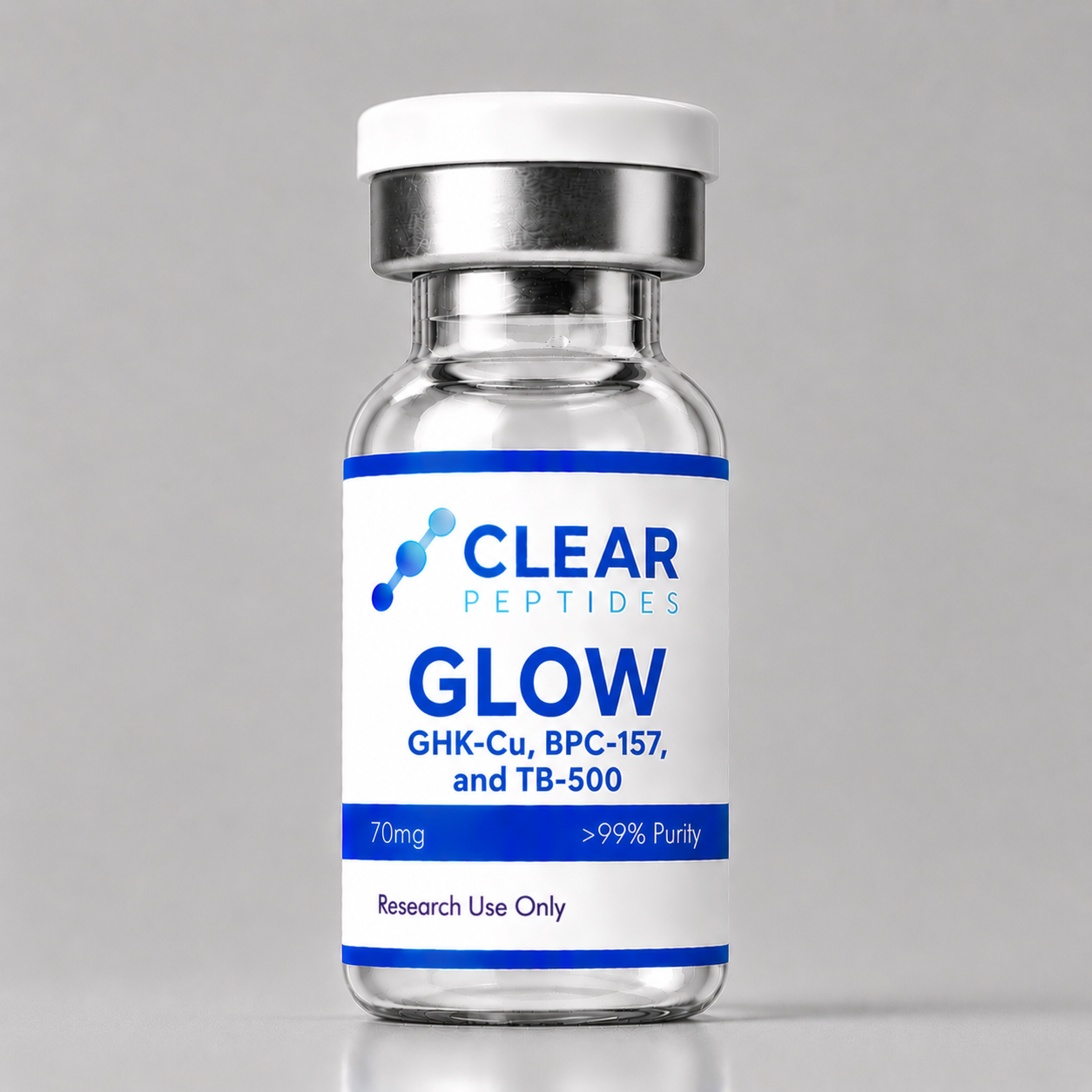
GLOW is a triple-peptide research blend combining BPC-157 (10mg), GHK-CU (50mg), and TB-500 (10mg) in a single lyophilized vial. This formulation enables simultaneous investigation of three complementary tissue remodeling pathways in the same experimental system.
The combination covers angiogenic signaling (BPC-157/VEGFR), copper-mediated ECM remodeling and gene expression regulation (GHK-CU), and actin cytoskeletal dynamics and endothelial migration (TB-500) — three mechanistically distinct but potentially synergistic research pathways.
Research Context Reported in Scientific Literature
GLOW Triple Blend has been evaluated in laboratory environments as described in peer-reviewed publications. Observations below are from controlled preclinical research models and do not constitute clinical evidence.
- Triple pathway co-investigation: Simultaneous VEGFR angiogenesis, GHK-CU ECM modulation, and TB-500 cytoskeletal signaling research
- Copper-mediated gene regulation: GHK-CU interactions with MMP expression, collagen synthesis, and antioxidant gene upregulation
- Multi-peptide synergy studies: Investigation of whether combined exposure produces independent, additive, or synergistic signaling responses
- Wound response signaling models: Research into coordinated cellular responses across multiple repair-associated pathways simultaneously
- ECM component expression: Collagen, elastin, fibronectin, and MMP activity studies in fibroblast and endothelial cell models
These observations are exploratory and not conclusive.
Format & Handling
Supplied in sterile laboratory glass vials containing lyophilized peptide material. Reconstitution with bacteriostatic water or an appropriate laboratory solvent is required prior to research use.
Handling and storage should follow institutional laboratory protocols to maintain stability, purity, and analytical integrity. Store sealed vials at −20°C, protected from light and moisture.
Frequently Asked Questions
🚚 How fast is shipping?
Orders placed before 2PM PST ship same day via FedEx 2-Day with cold-chain packaging. Most orders arrive within 2 business days.
📦 When will I receive my tracking number?
Tracking is emailed immediately upon dispatch, typically within 24 hours of order placement.
🧪 How do you verify purity and quality?
Every lot undergoes independent third-party RP-HPLC purity analysis and ESI-MS identity confirmation. Lot-specific COAs are available via our COA Lookup tool.
💳 What payment methods do you accept?
We accept major credit cards via our secure Bankful payment gateway. All transactions are encrypted and processed securely.
↩️ What is your refund policy?
All sales are final unless the issue results from a verified error or quality failure on our part. See our Refund Policy for full details.
❄️ How should I store this product?
Lyophilized powder should be stored at −20°C in a sealed, desiccated container protected from light. Avoid repeated temperature cycling. After reconstitution, store at 2–8°C and use within 72 hours.
Intended Use: Research use only. Not for human consumption, medical, veterinary, or diagnostic use. Research findings are preliminary and do not imply safety or efficacy.